


Phil Housley’s Vision and the Special Teams Puzzle: Inside the LA Kings’ Crucial Training Camp
The Los Angeles Kings are hurtling toward a 2026-27 season defined by urgency. With an aging core, a retooled roster, and a completely new coaching staff led by Peter Laviolette, the margin for error is razor-thin. General Manager Ken Holland has pushed all his chips into the center of the table, banking on veteran additions like Mats Zuccarello, Erik Haula, and Corey Perry to complement stars like Artemi Panarin and Quinton Byfield.
But talent alone won’t dictate the Kings’ success this season. The true test lies in execution, particularly in areas that plagued the team last year. As training camp approaches, two massive storylines have emerged: the implementation of a new, aggressive defensive system under Associate Coach Phil Housley, and the urgent need to fix a disastrous special teams unit that Laviolette has inherited.
Phil Housley Wants the Kings to “Attack the Game”
When Peter Laviolette was hired as head coach, his first call was to Phil Housley. The two have a long history of success together, having reached the Stanley Cup Final with the Nashville Predators and coming within two games of the Final with the New York Rangers in 2024. Housley, a Hall of Fame defenseman known for his prolific offensive production, has been brought in to serve as Laviolette’s Associate Coach, specifically tasked with revamping the Kings’ blue line.
In a recent interview, Housley made his philosophy crystal clear: he wants the Kings’ defensemen to “attack the game.”
“If we’re going to be in the picture of a really good hockey team, we’re going to have to get some more production of our defensemen without being a liability,” Housley stated. “They’re going to have to get up in the rush. We have to create that four-man attack. That’s going to be a must, there’s no negotiation on that.”
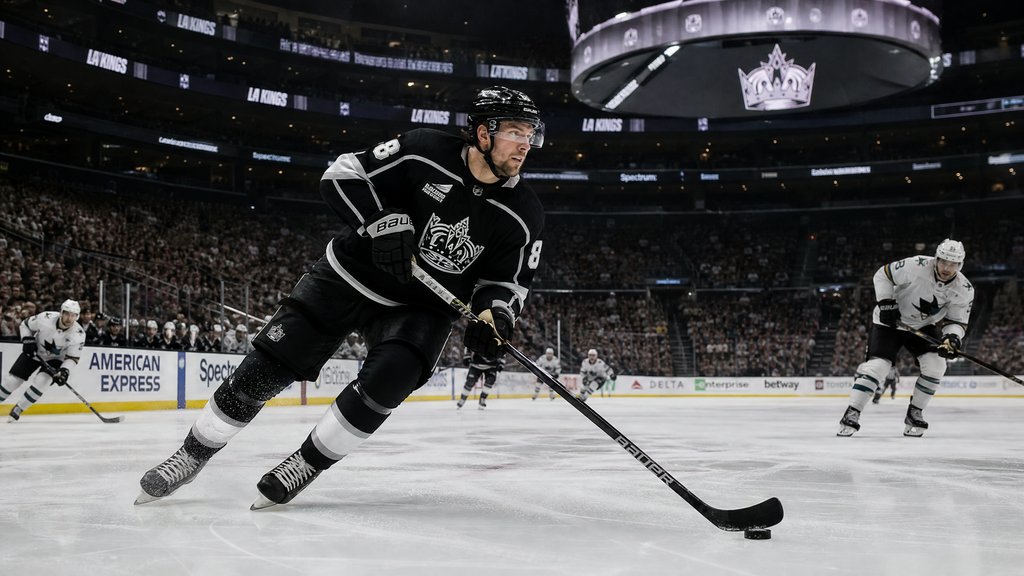
This represents a significant shift from the more conservative, possession-heavy systems the Kings have employed in recent years. Housley is demanding a higher level of aggression, requiring defensemen to join the rush, pinch down the walls in the offensive zone, and sustain pressure.
“I don’t know if they were able to do that last year or I think they could have been a little bit more aggressive without being reckless,” Housley observed. “We’ve got to be able to go under, slam walls, keep the puck and sustain pressure on the opposition.”
This system is tailor-made for a player like Brandt Clarke, the highly touted young defenseman who recently signed a five-year extension. Clarke’s elite offensive instincts and skating ability should flourish under Housley’s guidance. However, the system also demands exceptional conditioning. Defensemen will be asked to cover more ice and expend more energy on the attack, requiring a commitment to fitness that Housley has already communicated to the players.
The addition of Erik Gustafsson, whom Housley coached successfully in New York, adds another layer of intrigue. Gustafsson’s mobility and puck-moving skills fit perfectly into this aggressive framework, and his presence will create intense competition among the seven NHL-caliber defensemen currently on the roster.
The Special Teams Dilemma
While Housley focuses on 5-on-5 aggression, Laviolette faces a monumental challenge on special teams. Last season, the Kings’ playoff hopes were severely undermined by a penalty kill that bled goals and a power play that went cold at the worst possible times.
Laviolette has inherited this major problem, and fixing it is paramount to the Kings’ success in 2026-27. The power play, in particular, should be a strength given the personnel. With Panarin, Byfield, Adrian Kempe, and Kevin Fiala, the Kings have the high-end skill necessary to operate a top-tier unit. The addition of Zuccarello, a proven playmaker, should also help orchestrate the attack.
However, the power play must become less predictable. Under the previous regime, the puck movement often stagnated, allowing penalty killers to easily anticipate the next pass. Laviolette will likely implement a more dynamic structure, encouraging quick puck movement, frequent shot generation, and aggressive net-front presence—a role perfectly suited for the newly acquired Corey Perry.
The penalty kill requires a complete overhaul. The Kings struggled with structure and clearing the crease last season, leading to far too many high-danger chances against. Laviolette’s teams are traditionally strong defensively, and he will demand a higher level of sacrifice and attention to detail from his penalty killers. Players like Erik Haula and Trevor Moore will be relied upon heavily in these situations.
Furthermore, Housley noted that he and Laviolette have a specific plan for 3-on-3 overtime and 4-on-4 situations. Last season, the Kings struggled in overtime, often appearing disjointed and overly attached to man-on-man coverage. Housley emphasized the need for a structured plan that allows players to use their skills while maintaining possession and creating confusion for the opposition.
“We have a really good, structured plan, 3-on-3 and 4-on-4 and I think it’s going to help,” Housley said. “I think you’ve got to allow the players to use their skills, that’s why they’re out there, but also within that framework is just have an idea what certain things are.”
Preseason Battles and the Road Ahead
The implementation of these new systems will begin in earnest when training camp opens in mid-September. The Kings have a robust preseason schedule designed to test the roster and finalize line combinations.
The exhibition slate begins with the “Empire Classic” against the Vegas Golden Knights on September 19 at Toyota Arena in Ontario. This will be the first opportunity for fans to see Laviolette’s system in action. The Kings will then face the Utah Mammoth on September 22, followed by a home-and-home series against the Anaheim Ducks on September 23 and 26.
Before the main camp opens, the organization’s top prospects will compete in the NHL Rookie Faceoff tournament in San Jose from September 12-15. This tournament will feature several players who recently participated in the World Juniors Summer Showcase, including Elton Hermansson and Henry Brzustewicz. The development of these young players is crucial, as the Kings will need inexpensive, entry-level contributors to balance their salary cap situation in the coming years.
The regular season officially kicks off on September 30 with a challenging road game against the Colorado Avalanche. This will be a massive early test for the Kings’ revamped defense and special teams. The home opener is scheduled for October 6 against the defending Eastern Conference champion Florida Panthers.
A Season of High Stakes
The 2026-27 season is a defining moment for the Los Angeles Kings. The front office has made bold moves, signaling a clear intent to compete for a championship right now. The hiring of Laviolette and Housley brings a wealth of experience and a demanding, aggressive coaching style to a locker room that needed a new voice.
The success of this campaign will hinge on how quickly the players adapt to the new systems. Can the defensemen execute Housley’s “four-man attack” without becoming defensive liabilities? Can Laviolette fix the special teams issues that plagued the team last year? And can the veteran additions mesh seamlessly with the established core?
The answers to these questions will determine whether the Kings are legitimate Stanley Cup contenders or a team destined for another early playoff exit. The talent is undeniable, the coaching staff is proven, and the expectations are sky-high. Now, the real work begins.
For more in-depth analysis and the latest updates on the LA Kings, be sure to check out the “LA Kings Weekly” show on our YouTube channel. We’ll be breaking down all the preseason action, analyzing the new coaching systems, and previewing the regular season as the Kings embark on this highly anticipated campaign.
