


The Los Angeles Lakers have emphatically answered the call. Facing a daunting first-round playoff matchup against the Houston Rockets without their two injured stars, Luka Doncic and Austin Reaves, the Lakers have not just survived—they have thrived. Following a gritty 101-94 victory in Game 2 at Crypto.com Arena, Los Angeles now commands a 2-0 series lead as the battle shifts to Texas. It is a testament to the sheer will of a 41-year-old LeBron James and the lethal sharpshooting of a revamped backcourt featuring Marcus Smart and Luke Kennard.
LeBron James Continues to Defy Father Time
At 41 years old, LeBron James is operating on a plane of existence that defies conventional basketball logic. In a game where the Lakers desperately needed offensive generation and physical dominance, James delivered a masterpiece. He led all scorers with 28 points, pulled down eight rebounds, and dished out seven assists in a grueling 39 minutes of action. His ability to control the tempo of a high-stakes playoff game remains unparalleled.
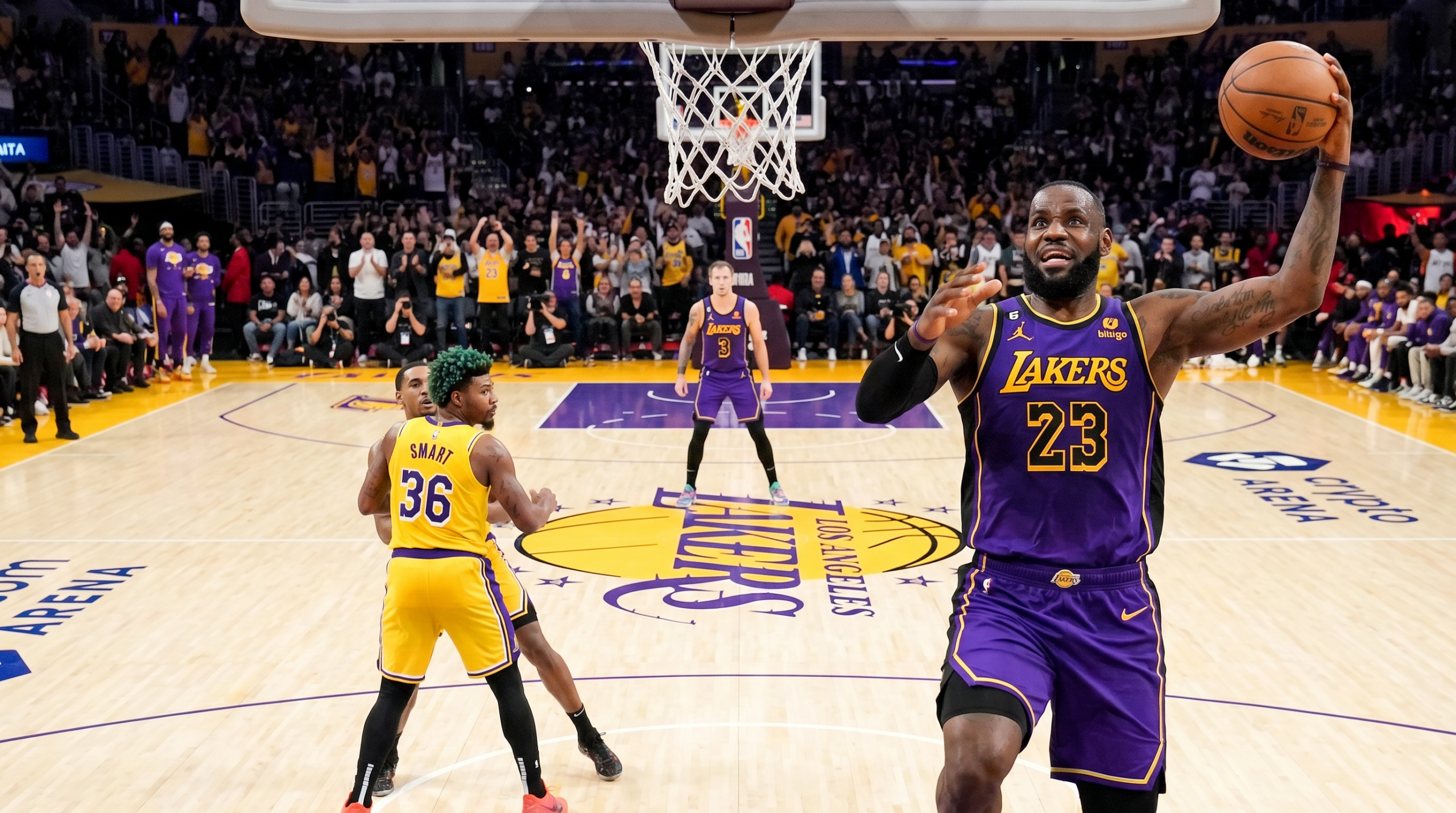
The defining moment of Game 2 arrived in the closing minute. With the Lakers clinging to a precarious lead, James drove to the basket and unleashed a soaring two-handed dunk, extending the advantage to 99-92 with just 55.3 seconds remaining. It was a play that sent the Crypto.com Arena crowd into a frenzy and effectively sealed the victory for Los Angeles.
Head coach JJ Redick was effusive in his praise of James’s approach. “He brought a level of physicality, and he’s done it throughout his career,” Redick noted after the game. “He’s just really comfortable playing that way whether it’s him on a back-down, getting to the basket or him drawing fouls. He forces you to match his physicality.” Indeed, James was relentless in attacking the rim, earning 14 trips to the free-throw line and converting 10 of them.
Following the game, a humbled James expressed his gratitude for being able to perform at such a high level. “Super blessed, super humbled,” he told reporters. The Lakers, severely depleted by injuries, are relying heavily on this ageless wonder, and so far, he has carried the burden flawlessly.
The Backcourt Brilliance of Smart and Kennard
When the news broke that Luka Doncic (Grade 2 hamstring strain) and Austin Reaves (left oblique strain) would be sidelined indefinitely, many pundits wrote off the Lakers’ chances against a potent Rockets squad. However, the insertion of Marcus Smart and Luke Kennard into the starting lineup has proven to be a masterstroke by Redick and his coaching staff.
Kennard, who led the NBA in three-point shooting percentage (47.8%) during the regular season, set the tone in Game 1 with a playoff career-high 27 points. He proved that performance was no fluke in Game 2, contributing 23 points, six rebounds, and three steals while playing nearly 42 minutes. His ability to stretch the floor has created crucial driving lanes for James and the rest of the Lakers’ frontcourt.
Marcus Smart, acquired for his defensive tenacity and veteran leadership, was the undeniable catalyst in Game 2. Smart erupted for 25 points, orchestrated the offense with seven assists, and disrupted the Rockets’ flow with five steals. He shot a blistering 8-for-13 from the field, including an incredible 5-for-7 from beyond the arc.
The duo combined to shoot 16-for-26 from the field and 8-for-13 from three-point range. “He just had a killer game tonight,” Redick said of Smart’s two-way dominance. The backcourt’s ability to seamlessly transition from lockdown defense to explosive offense has completely altered the trajectory of this series.
Stifling Kevin Durant and the Rockets’ Offense
The return of Kevin Durant to the Rockets’ lineup for Game 2 added a layer of complexity to the Lakers’ defensive game plan. Durant, who missed Game 1 with a bruised right knee, looked unbothered early on, pouring in 20 points in the first half. It appeared the future Hall of Famer was poised to single-handedly even the series.
However, the Lakers made brilliant halftime adjustments. They began aggressively sending double-teams at Durant, forcing the ball out of his hands and daring the rest of the Rockets roster to beat them. The strategy worked to perfection. Durant was held to just three points in the second half and committed a staggering nine turnovers for the game.
Durant finished with 23 points on an efficient 7-of-12 shooting, but his impact was severely muted down the stretch. “Glad to be out there, playing in high-pressure moments,” Durant reflected postgame. “But bad game for me tonight. When two, three people are on me and I shoot, we can get an offensive rebound. I’ve got to shoot more of those and put my teammates in better position.”
The Lakers’ defense has been the unsung hero of this series. They have successfully held the high-octane Rockets offense under 100 points in consecutive playoff games, a remarkable feat considering the offensive firepower Houston possesses.
The Three-Point Disparity Tells the Story
A deep dive into the statistics reveals a glaring disparity that has heavily favored the Los Angeles Lakers: three-point shooting. Through the first two games of the series, Los Angeles is shooting a scorching 48.9% from beyond the arc. In stark contrast, the Rockets are struggling to find their rhythm from deep, connecting on just 29% of their three-point attempts.
In Game 2 alone, the Lakers drained 13 three-pointers on 46.4% shooting, compared to the Rockets’ dismal 7-for-29 (24.1%) performance from long distance. The ability of Kennard, Smart, and Rui Hachimura (who chipped in 13 points and three triples in Game 2) to consistently knock down outside shots has demoralized the Houston defense and prevented them from packing the paint against LeBron James.
The Rockets’ young core, including Alperen Sengun (20 points, 11 rebounds) and Jabari Smith Jr. (18 points), has shown flashes of brilliance, but their inability to space the floor effectively has allowed the Lakers’ defense to collapse and protect the rim.
The Impact of the Missing Stars
The absence of Luka Doncic and Austin Reaves cannot be overstated, yet the Los Angeles Lakers have managed to mask this massive void with sheer determination and tactical execution. Prior to their injuries, Doncic and Reaves were the engines of the Lakers’ offense, combining to average a staggering 56.8 points, 13.8 assists, and 12.4 rebounds per game during the regular season. Losing that level of production would derail most championship contenders, but the Lakers have embraced the “next man up” mentality with open arms.
Doncic, dealing with a Grade 2 hamstring strain, even traveled to Spain earlier this month to undergo specialized medical treatment in hopes of accelerating his recovery. While he is officially out indefinitely and not expected to return for this first-round series against the Rockets, his commitment to his rehabilitation underscores the Lakers’ championship aspirations. Reaves, suffering from a left oblique muscle strain, is reportedly further along in his recovery process and has begun some on-court activities. If the Lakers can continue to hold the fort, his potential return later in the playoffs could provide a massive boost.
In the meantime, the burden falls squarely on the shoulders of the available roster. The fact that the Los Angeles Lakers have not only survived but dominated the first two games against a fully healthy Houston Rockets team speaks volumes about their depth and resilience. It also highlights the masterful coaching job by JJ Redick, who has seamlessly integrated new pieces into prominent roles and devised defensive schemes that have completely neutralized the Rockets’ primary weapons.
Looking Ahead: The Challenge in Houston
As the series shifts to the Toyota Center in Houston for Game 3 on Friday night, the Los Angeles Lakers find themselves in a commanding position. Historically, teams that take a 2-0 lead in a best-of-seven NBA playoff series go on to win the series over 92% of the time. However, the Lakers are well aware that the job is far from finished.
The Rockets are expected to play with a heightened sense of desperation on their home floor. Houston head coach Ime Udoka will undoubtedly make adjustments to free up Kevin Durant and generate better looks from the perimeter. The Rockets have acknowledged that the Lakers are “daring us to shoot,” and they must find a way to capitalize on those opportunities to claw their way back into the series.
For the Los Angeles Lakers, the focus remains on maintaining their defensive intensity and riding the momentum of their veteran leaders. While Luka Doncic is not expected to return during this series, there is cautious optimism that Austin Reaves could potentially make an appearance if the series extends. Until then, the Lakers will continue to lean on the heroics of LeBron James and the unexpected brilliance of their supporting cast.
Coach Redick summed up the team’s mentality perfectly: “We’re just getting this thing started. He’s the type of player who can take over a series. We just have to continue to have great team defense and great activity.”
The Los Angeles Lakers have proven that heart, strategy, and legendary talent can overcome significant adversity. As they prepare for a hostile environment in Houston, they carry the confidence of a team that knows exactly who they are and what they are capable of achieving. The basketball world is watching, and the Los Angeles Lakers are putting on a show for the ages.
