


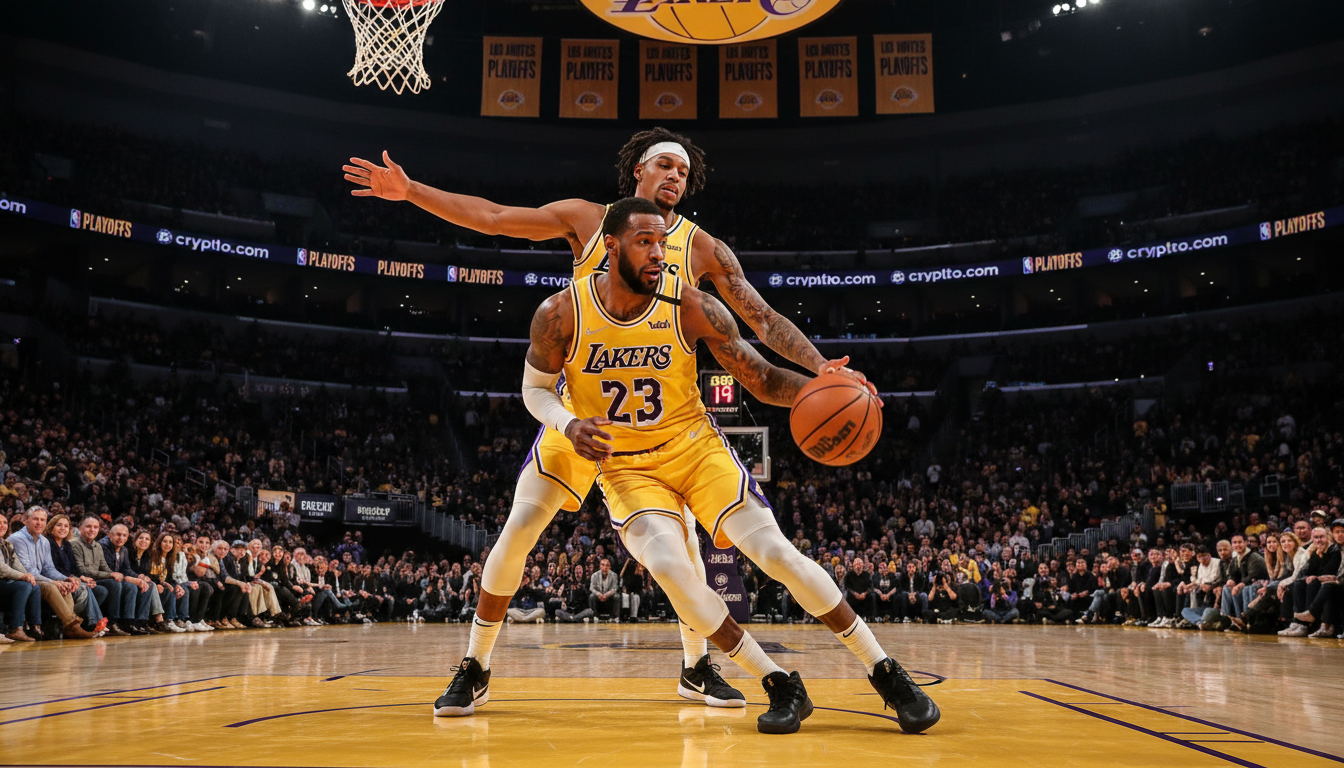
The 2025-26 NBA season for the Los Angeles Lakers has officially concluded, and it ended in a manner that few could have predicted just weeks prior. Following a resilient first-round victory over the Houston Rockets, the Lakers were unceremoniously swept by the top-seeded Oklahoma City Thunder in the Western Conference Semifinals. The final blow came in a 115-110 Game 4 defeat at Crypto.com Arena, sending the purple and gold into an offseason fraught with uncertainty, massive financial decisions, and the looming shadow of an aging legend’s potential departure.
The abrupt end to a campaign that once held such promise—highlighted by a 53-win regular season and a dominant stretch in March—forces the organization to confront the harsh realities of their current roster construction. With injuries derailing their playoff push and key players entering free agency, the Los Angeles Lakers are at a crossroads that will define the franchise’s trajectory for years to come.
The Thunder Sweep: A Harsh Reality Check
The Western Conference Semifinals matchup against the Oklahoma City Thunder was always going to be a daunting task, but the 4-0 sweep laid bare the vulnerabilities of the Los Angeles Lakers. The Thunder, led by back-to-back MVP Shai Gilgeous-Alexander, executed with precision and defensive intensity that the Lakers simply could not match. Gilgeous-Alexander was spectacular throughout the series, capping it off with a 35-point performance in Game 4, including nine crucial points in the fourth quarter to seal the victory.
The Los Angeles Lakers struggled with turnovers and execution against the Thunder’s blitzing defense. In Game 1, a 108-90 loss, the Lakers committed 18 turnovers—well above their season average—allowing Oklahoma City to dictate the pace. The series scores told a damning story: Thunder 108, Lakers 90; Thunder 125, Lakers 107; Thunder 131, Lakers 108; Thunder 115, Lakers 110. Despite a valiant effort in Game 4, where the Lakers rallied but ultimately fell short, the series highlighted a glaring disparity in depth, youth, and defensive discipline between the two squads.
Head coach JJ Redick acknowledged the challenges, noting that the margin for error against a championship-caliber team like the Thunder was razor-thin. “When we made game plan mistakes, they hurt us,” Redick stated after Game 1. The inability to consistently execute under pressure, compounded by the absence of their primary offensive engine, proved insurmountable.
The Luka Dončić Factor: An MVP Campaign Derailed
Perhaps the most significant storyline of the Los Angeles Lakers’ late-season collapse was the devastating injury to Luka Dončić. Acquired in a blockbuster move that reshaped the franchise, Dončić put together an MVP-caliber season, leading the NBA in scoring with an astounding 33.5 points per game. His brilliance was the driving force behind the Lakers’ 15-2 run in March, a stretch where he averaged 37.5 points, 8.0 rebounds, and 7.4 assists, earning Player of the Month honors.
However, disaster struck on April 2 when Dončić suffered a Grade 2 left hamstring strain against the Thunder. The injury sidelined him for the remainder of the regular season and the entirety of the playoffs. Without his unparalleled ability to dictate tempo and create offense, the Los Angeles Lakers were forced to rely heavily on an aging LeBron James and a returning Austin Reaves, who himself missed significant time with an oblique strain.
The absence of Dončić was palpable against Oklahoma City. The Lakers lacked the offensive firepower and playmaking necessary to keep pace with the Thunder’s dynamic attack. Dončić’s season—which included a 60-point performance against the Miami Heat and two Player of the Month awards—deserved far more recognition. Despite leading the NBA in scoring, he finished fourth in MVP voting behind Shai Gilgeous-Alexander, Nikola Jokić, and Victor Wembanyama. Coach Redick was openly “disappointed” by the snub, arguing that Dončić’s contributions were consistently undervalued by the national media narrative.
The King’s Court: LeBron James’ Uncertain Future
As the dust settles on the season, all eyes turn to LeBron James. At 41 years old, completing his 23rd NBA season, James continues to defy the laws of basketball physics. He averaged 20.9 points, 7.2 assists, and 6.1 rebounds—numbers that are unprecedented for a player of his age and mileage. Yet, despite his enduring greatness, the Los Angeles Lakers find themselves grappling with his impending free agency.
Reports indicate that James is likely to opt out of his contract, becoming an unrestricted free agent. This decision opens the door to myriad possibilities, from re-signing with the Lakers on a new deal to exploring opportunities elsewhere in pursuit of another championship ring. James himself was characteristically measured when asked about his future after the Game 4 loss: “I don’t know what the future holds for me. As it stands tonight… I’ll sit back and recalibrate with my family. When the time comes, you guys will know what I decide.”
The Lakers’ front office, led by Rob Pelinka, has expressed a deep desire to retain James. “Of course, any team, including ours, would love to have LeBron James on their roster,” Pelinka remarked during the season-ending press conference. However, retaining James is only part of the equation. The organization must demonstrate a clear path to contention, which requires significant roster upgrades and financial maneuvering. The question remains: Can the Los Angeles Lakers build a championship-caliber supporting cast around James and Dončić while navigating the restrictive NBA salary cap?
The Austin Reaves Dilemma: A Bidding War Looms
Complicating the Los Angeles Lakers’ offseason plans is the impending free agency of Austin Reaves. The 27-year-old guard is coming off a career year, averaging 23.3 points, 4.7 rebounds, and 2.3 made three-pointers per game on 36% shooting from beyond the arc. Reaves has developed into an indispensable piece of the Lakers’ core, providing scoring, playmaking, and the kind of competitive grit that defines winning teams.
Reaves is expected to decline his player option, entering the open market as one of the most coveted free agents available. NBA executives predict that Reaves could command a multi-year contract in the range of $40 million per season. Teams with cap space, such as the Brooklyn Nets, Chicago Bulls, and Utah Jazz, are reportedly preparing to make significant offers. The Atlanta Hawks have also shown interest.
The Los Angeles Lakers have made it clear that retaining Reaves is a top priority. “He started his journey here as a Laker and has made it very clear to us that he wants his journey to continue as a Laker,” Pelinka stated. However, matching massive outside offers will push the Lakers deep into the luxury tax, potentially committing over $90 million annually to the backcourt tandem of Reaves and Dončić alone. Despite the financial strain, losing Reaves would be a devastating blow to the team’s identity and cohesion.
Roster Reconstruction: Seeking Depth and Athleticism
The sweep at the hands of the Thunder exposed a critical flaw in the Los Angeles Lakers’ roster: a lack of reliable depth and perimeter athleticism. While the starting lineup, when healthy, can compete with anyone, the drop-off in production from the bench was stark. The Thunder’s depth allowed them to maintain relentless pressure throughout all four games—a luxury the Lakers simply did not possess.
Rob Pelinka emphasized the need to address these deficiencies during the offseason. “If you look around the playoffs right now, I think depth is really important, athleticism and youth,” Pelinka noted. “We have a lot of components of that on our roster, but we need to add to it.” The front office will need to be creative in their approach, leveraging the NBA Draft, targeted trades, and veteran minimum signings to bolster the rotation. Finding two-way players who can defend the perimeter and knock down open shots will be paramount.
There are also questions surrounding Rui Hachimura, who has hinted at a possible departure. The versatile forward was a key contributor during the regular season and provided some bright spots in the playoff run, but his future in Los Angeles remains uncertain. Retaining or replacing his production will be another item on the Lakers’ already lengthy offseason checklist.
The Coaching Evolution: JJ Redick’s Second Year
Despite the disappointing playoff exit, there are genuine positives to draw from JJ Redick’s second season as head coach. Redick guided the Los Angeles Lakers to 53 wins, navigating significant injuries to key personnel throughout the campaign. He demonstrated tactical flexibility and fostered a resilient team culture that earned praise from players and the front office alike. Notably, Redick became only the fourth coach in franchise history to win 50 games in each of his first two seasons, joining Phil Jackson, Pat Riley, and Paul Westhead.
“It ended up being a really hard-playing team, a really together team, and a team with a lot of heart,” Redick reflected. The coach acknowledged the need for continued growth, both for himself and his staff, as they prepare for the challenges of the upcoming season. His ability to integrate new pieces and maximize the talent on the roster will be heavily scrutinized as the Lakers aim to return to championship contention.
Looking Forward: A Pivotal Summer for the Purple and Gold
The upcoming offseason is arguably the most critical in recent Los Angeles Lakers history. The decisions made in the coming months will dictate whether the franchise can maximize the remaining years of LeBron James’ career and capitalize on the prime of Luka Dončić. The to-do list is extensive: secure LeBron James, navigate the Austin Reaves bidding war, improve roster depth and athleticism, address the Rui Hachimura situation, and ensure Dončić returns to full health.
It is a complex puzzle that Rob Pelinka and the front office must solve under the intense scrutiny of a fan base that expects nothing less than championships. While the sting of the Thunder sweep lingers, the foundation of a contender remains. The combination of James, Dončić, and Reaves—if retained—provides a formidable core. However, as the 2025-26 season proved, top-heavy rosters are vulnerable to the physical toll of an NBA season. The Los Angeles Lakers must learn from this experience, building a team that is not only talented but resilient and deep enough to withstand the rigors of a deep playoff run.
As the NBA Draft and free agency approach, the Los Angeles Lakers are on the clock. The moves they make will reverberate throughout the league, setting the stage for what promises to be a fascinating 2026-27 campaign. For Lakers fans, the time for reflection is brief; the time for action is now. For more in-depth basketball analysis and coverage, be sure to check out our YouTube channel and tune in to LA Sparks Weekly for all the latest from the world of Los Angeles basketball.
